

By Bilkis Abdulraheem Lawal
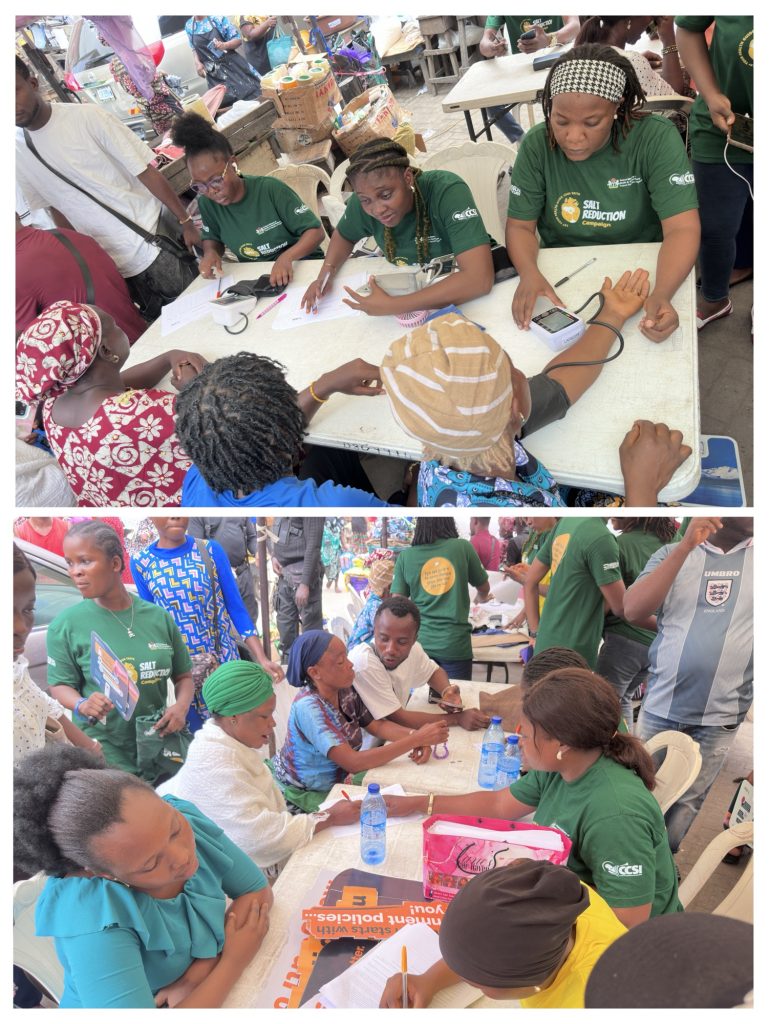
The Federal Ministry of Health and Social Welfare, in partnership with the Centre for Communication and Social Impact (CCSI), has launched a community-based salt reduction campaign at Oke-Arin Market on Lagos Island, Lagos.
The initiative seeks to address the growing burden of hypertension and cardiovascular diseases linked to excessive salt consumption among Nigerians.
Speaking at the event, Dr Olawale Ogunlana described high salt intake as a significant risk factor for hypertension, commonly known as high blood pressure.
“Salt consumption is a risk factor for hypertension. Many people are unaware of how much salt they consume daily, and we cannot entirely fault them,” he said.
He explained that the World Health Organisation recommends a daily intake of no more than five grammes of salt approximately one teaspoon.
“Beyond adding salt during cooking, many Nigerians unknowingly consume high levels of sodium through seasoning cubes and processed foods. An average person may add salt and still include seasoning cubes, not realising both contain significant sodium,” Dr Ogunlana noted.
He clarified that the campaign does not advocate total elimination of salt but encourages moderation.
“We are not saying salt elimination; we are saying salt reduction. Salt is important for the body, but excess consumption can damage the heart and kidneys, increase the risk of hypertension, and lead to stroke or paralysis,” he stated.
Dr Ogunlana also encouraged Nigerians to adopt healthier cooking practices by using natural spices such as ginger, garlic and onions to enhance flavour, rather than relying heavily on salt and sodium-based seasonings.
He further stressed the importance of regular physical exercise in lowering blood pressure and improving overall wellbeing.
Scientific Officer at the Federal Ministry of Health and Social Welfare, Victor Osuagwu, said Nigerians consume far more salt than the World Health Organisation’s recommended limit.
“The average Nigerian consumes more than the WHO standard for salt intake, and this contributes significantly to cardiovascular diseases in the country,” he said.
Mr Osuagwu identified behavioural patterns and poor awareness as key drivers of excessive salt consumption.
“Many consumers do not read food labels. We buy products because they are attractive or popular, without checking the sodium levels. This contributes to hypertension, stroke and other cardiovascular conditions,” he added.
On her part, the Media and Programme Officer of CCSI, Ms Anna White-Agbo, said the organisation partnered with the ministry to ensure effective social and behavioural change communication.
“Our role is to ensure that health messages translate into behavioural change. This salt reduction campaign has been ongoing for over a year, both online and through community outreach,” she explained.
According to her, the campaign has reached hundreds of people directly through blood pressure screenings and counselling sessions, with plans for further expansion across Nigeria, subject to funding availability.
Leave a Reply