
By Damilola Fajinmi
Johannesburg, South Africa — The recently concluded G20 Summit in Johannesburg has cast a renewed spotlight on the care economy, positioning childcare as a vital yet undervalued driver of inclusive growth across Sub-Saharan Africa.
Fresh findings from Economist Impact’s Childcare Dividend Initiative (CDI) reveal that inadequate access to affordable, quality childcare cost the economies of Nigeria, Kenya, and South Africa billions in lost income in 2022. The report highlights that millions of capable mothers were unable to join the workforce, underscoring the view that childcare investment transcends social welfare, it is an economic necessity.
“Access to affordable, quality childcare is not a luxury; it is an economic necessity,” stated Katherine Stewart, Lead Researcher at Economist Impact. “Our findings demonstrate that childcare should be viewed not as a cost, but as a strategic investment that fuels productivity, bolsters economies, and fosters inclusive growth.”
According to the study, achieving universal childcare enrolment by 2030 could enable millions of mothers across the three nations to enter the labour market. Nigeria stands to benefit most significantly, with an estimated 1.7 million additional working mothers contributing to the economy, potentially increasing the nation’s GDP by up to 1.09% through higher household incomes and expanded tax revenues.
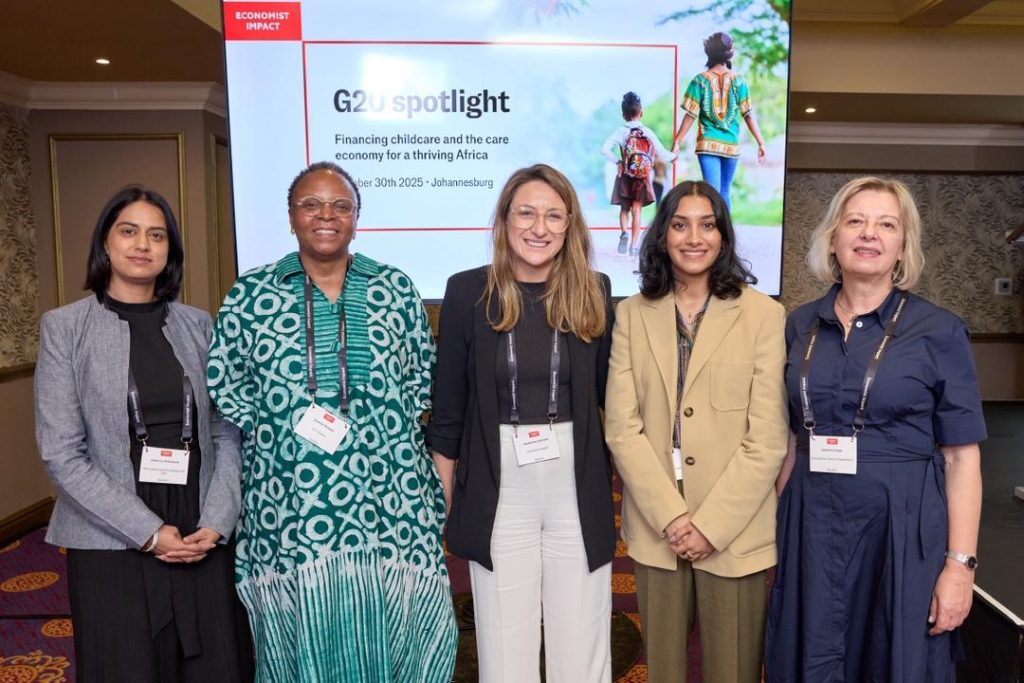
To further amplify these insights, Economist Impact, with support from the William and Flora Hewlett Foundation, convened a high-level forum on the sidelines of the G20 Women’s Economic Empowerment Working Group (WEEWG) Ministerial Meeting. The gathering brought together policymakers, funders, care providers, and civil society leaders to deliberate on how targeted childcare investment can advance gender equality, promote early childhood development, and strengthen national economies.
Speakers pointed to promising examples, including Kenya’s national care strategy, while stressing the need for cross-sector collaboration among the ministries of finance, health, education, and social development to build sustainable and integrated care systems.
“Childcare can represent a significant financial strain for many families, but expanding affordable, quality care can also serve as one of the strongest engines for decent job creation,” remarked Jasmina Papa, Social Protection Specialist at the International Labour Organisation (ILO). “Investing in the care economy is both an economic and social imperative. Care is a public good: we have all benefited from it, and at some point, we will all provide it.”
Experts at the summit further urged governments to embed care economy frameworks within national development and fiscal policies. “Gender-responsive budgeting offers a clear lens to evaluate how public spending truly benefits women and men, but gender tagging alone is insufficient,” observed Juhi Kasan, Project Lead for Economies of Care at the Institute for Economic Justice in South Africa.
The Childcare Dividend Initiative concludes that strong, well-resourced care systems are the backbone of resilient and equitable economies, when care works, economies thrive.
Leave a Reply